Stake account restriction in India: terms, KYC and complaint evidence
A dated Stake account-restriction investigation for India covering exact-domain identity, KYC notices, balance records, support replies and evidence limits.

Important evidence remains open
Why amber: Stake terms describe operator-controlled restriction and verification powers, but no account file or Indian authority decision was available for a case-specific conclusion. Indian law, payment guidance and unverified public reports answer different questions. The missing private chronology requires amber.
What could change the colour: A complete account record and attributable final response could narrow the finding. Current Indian primary authorisation matching the exact entity and permitted activity could support a greener reassessment; an official adverse record or corroborated documented conduct could support a narrowly framed red conclusion.
The Stake signal measures available evidence, not safety, legality, quality, winnings or the likely result of a complaint.
Questions and entities checked
Primary task: Document a Stake account restriction or closure affecting access to funds in India.
Supporting tasks: verify the exact host and contracting identity; separate KYC review from account closure; preserve the balance and transaction chronology; use the recorded support and payment routes; assess public reports without treating them as proven. The named entities required are Stake, stake.com, Medium Rare N.V., MeitY, NPCI, the account holder's bank, NCRP, Trustpilot and iGaming Ontario.
Indian search variants considered were Stake account restricted India; Stake account closure complaint; Stake KYC restriction India; Stake balance access evidence; Stake support final response; Stake account review timeline; Stake complaint documents. They are answered through the evidence and decision sequence rather than treated as proof.
| Evidence layer | Dated observation through 14 August 2026 | Permitted conclusion |
|---|---|---|
| Indian primary law | MeitY bare Act · IN-S02 · accessed 9 August 2026 | Indian statutory layer; no brand endorsement |
| Operator statement | Stake Terms of Service · IN-S18 · checked 11 August 2026 | Identity and rules claimed for the stated scope |
| Payment record | NPCI UPI guidance · IN-S04 · accessed 9 August 2026 | Payment-rail and complaint starting point |
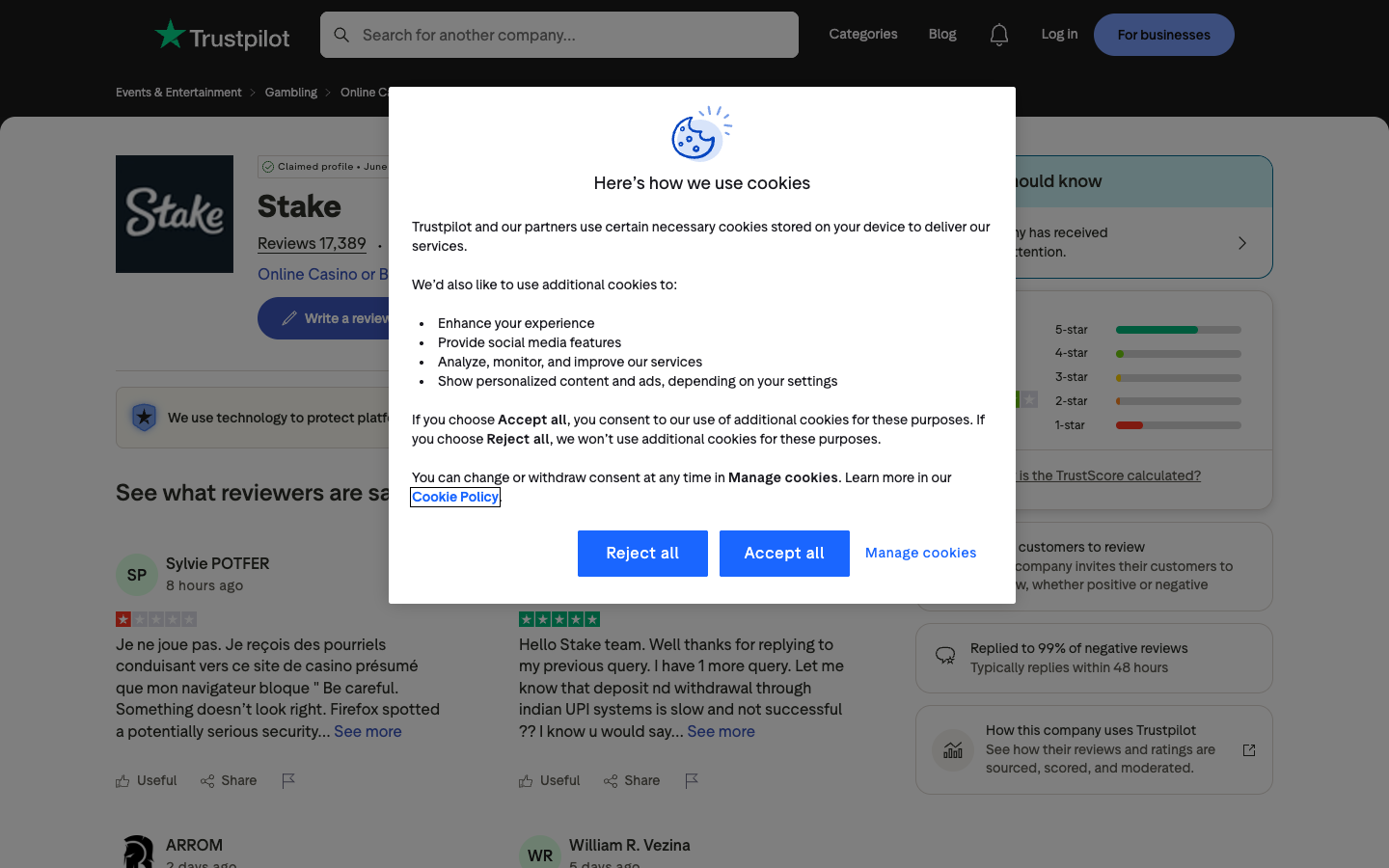
| User signal | Trustpilot profile · IN-S19 · captured 29 July 2026 | Unverified public reports, never findings |
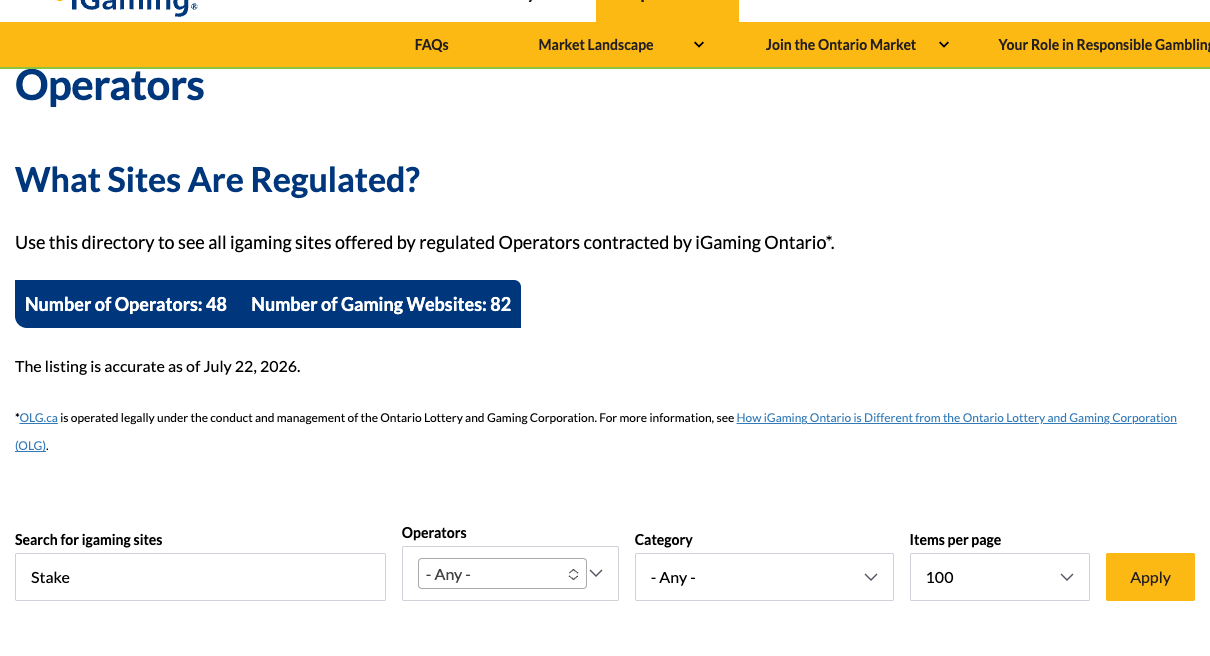
| Foreign primary context | iGaming Ontario directory · IN-S20 · captured 29 July 2026 | Ontario-only entity or directory comparison |
Connect every claim to the exact channel
The identity check begins with stake.com and the legal identity stated in the recorded terms. A support profile, mirror, payment descriptor or copied logo cannot be joined to that identity without a reliable link. Record the login host, email domain, ticket route and policy URL before sending documents. Foreign licence wording is an operator statement within its stated territory, not Indian authorisation.
For Stake, the Indian primary layer is the Promotion and Regulation of Online Gaming Act 2025 in the recorded MeitY sources, including the research package’s 22 April 2026 commencement observation. Foreign permissions, operator localisation and INR presentation do not displace that layer. A state-specific legal question may still require qualified Indian advice; no reader’s individual circumstances were reviewed.
Open Stake terms, privacy, KYC, payment, withdrawal, support and complaint material from the same exact host. Record every legal entity and jurisdiction. A mismatch is an open evidence point. Do not use a deposit, document upload or VPN workaround as an identity test.
Operator wording is evidence of a statement
The recorded terms set out eligibility, verification, account controls, deposits, withdrawals and dispute-related powers. A clause can show that a power is claimed, but cannot prove why it was used or whether a particular decision complied with the contract. Keep the notice, policy version, requested documents, upload channel, deadlines, replies and final outcome in chronological order.
Stake verification can involve sensitive information, so the collection channel and privacy controller matter as much as the document list. An operator may state that it can restrict an account or ask for source-of-funds evidence; that clause does not prove a particular decision was correct. Preserve the request, response and applicable version. Keep full originals secure and send only redacted material through the editorial correction route.
| Question | Evidence to keep | Insufficient substitute |
|---|---|---|
| Exact channel | Full domain, app package, redirect and date | A name or logo alone |
| Contracting identity | Terms and privacy record from the same host | Search snippet or copied footer |
| Payment event | Bank/app status, beneficiary, amount and UTR | Gaming balance screenshot alone |
| Withdrawal event | Operator ledger plus bank credit or trace response | Processed label without bank match |
| Complaint outcome | Complete ticket, final response and attributable decision | One public review or support excerpt |
Reconcile two ledgers before making a claim
Record the available balance, locked or pending amount, each deposit or withdrawal ID, bank entry and UTR before contacting support. The gaming ledger and bank ledger are separate. A status label does not prove bank settlement, while a bank debit does not prove credit to the intended account. Never pay an additional release charge to an unverified contact.
For a Stake payment event, NPCI material supports UPI operation and the payment-complaint starting point. It cannot decide the operator contract or promise recovery. RBI CMS may concern an eligible regulated-entity complaint after its process; NCRP and 1930 concern suspected financial cyber fraud. Choose the route from the event facts, and keep separate acknowledgements.
An account shows ₹18,000 available on 10 August, then displays restricted after a KYC request. The user saves the balance, request, upload receipt and support ticket. The bank ledger shows no new movement. The bounded record says access changed after the request; it does not say funds were confiscated, KYC was unlawful or a crime occurred. A later final response and bank movement should be appended.
Two hosts, two narrow propositions
The Stake screenshots are dated source-appearance evidence. The Trustpilot capture does not verify a reviewer, domain, jurisdiction or outcome. The iGaming Ontario capture concerns Ontario and has no Indian legal effect.
Keep allegation, reply and outcome separate
Use the support route connected to the same recorded host and request a written reason, policy clause, affected amount, review status and appeal or complaint step. Preserve the complete response. Trustpilot reports can identify recurring questions worth checking, but cannot establish account ownership, Indian jurisdiction, transaction facts or the correctness of a restriction.
No case-specific Stake response was requested for the editorial investigation. A published response, if later supplied, would be labelled as the operator’s statement and checked against primary or transaction evidence. Silence would be recorded as no response by the stated deadline, not as proof of an allegation. Material corrections use the editorial correction form with the URL, exact disputed wording and dated evidence.
Pause when one link is missing
For Stake, first verify Indian legal scope. Then match the exact host or app to the contracting entity. Next read KYC, privacy, payment, withdrawal and complaint rules for that channel and date. Finally, compare any money movement with the real bank or UPI ledger. If one link fails, do not compensate with a small test payment or more identity data.
An adult who independently completes the Stake checks and still chooses to compare a commercial route may visit a checked casino option for adults. The sponsored link makes no promise about legality, safety, winnings, KYC or withdrawals. Choosing not to play is always valid.
Money already moved in a Stake matter takes priority over brand debate. Use the failed UPI evidence route, 1930/NCRP guidance or the account-restriction checklist according to the facts.
Test the missing link before escalating
A restriction file should answer four separate questions: which exact channel controlled the account, what the operator said it required, what happened in the operator ledger, and what happened in the bank or UPI ledger. Keeping those propositions apart prevents an email notice from becoming proof of a payment outcome. The same discipline also allows an operator response to be added without erasing the earlier observation.
If access returns, retain the restriction period, explanation and restored-balance record. If access remains unavailable, ask for a final written response and preserve any payment reference supplied. Suspected impersonation or unauthorised movement belongs with the bank or UPI app and, where facts support it, 1930/NCRP. A contractual disagreement alone is not automatically cyber fraud.
| Decision point | Record to examine | Bounded status |
|---|---|---|
| Host and identity | Full login host, terms entity and support domain | Open until all three match |
| Restriction notice | Timestamp, stated reason and policy clause | Operator statement only |
| Money position | Balance history, bank entry and UTR | Two ledgers reconciled separately |
| Final response | Complete ticket and attributable outcome | No outcome inferred from silence |
Evidence reviewed without a test account
Author: CasinoCheck India Research Desk. Editor: CasinoCheck India Evidence Review Desk. The Stake material observation date is 14 August 2026. The method compared Indian primary records, operator-controlled terms, payment guidance, a foreign primary directory and a dated user-signal profile. Primary records outrank operator statements; neither turns a user report into a fact.
No Stake account was opened, KYC submitted, INR deposited, collect request approved, wager placed, withdrawal attempted or support ticket created. No complaint count, payment speed or personal legal outcome is claimed. Domains, terms, payment routes and public profiles can change after review.
Stake corrections should include the canonical URL, disputed sentence, strongest dated source and desired factual change. Never submit a PIN, OTP, password, full Aadhaar, card secret or unrelated bank history.
Frequently asked questions
Why can a Stake account be restricted?
The recorded terms describe verification and account-control powers. Only the complete notice, policy version and account chronology can explain a specific event.
What evidence should I keep after a Stake account closure?
Keep the exact host, account and ticket IDs, balance history, restriction notice, KYC requests, policy version, bank records and final response.
Can a public Stake complaint prove my case?
No. A public report is contextual unless its identity, transaction records, correspondence and outcome are independently verified.
Where should an Indian user report suspected payment fraud?
Contact the bank or UPI app promptly and use 1930/NCRP when the facts indicate suspected financial cyber fraud. Keep each acknowledgement separately.
Sources placed beside supported claims
IN-S02Bare Act: Promotion and Regulation of Online Gaming Act 2025MeitY · Primary · accessed 2026-08-09 · reviewed for the 2026-08-14 publicationIN-S03National Cyber Crime Reporting PortalIndian Cybercrime Coordination Centre · Primary · accessed 2026-08-09 · reviewed for the 2026-08-14 publicationIN-S04UPI product and complaint supportNPCI · Primary · accessed 2026-08-09 · reviewed for the 2026-08-14 publicationIN-S18Stake Terms of ServiceStake · Operator statement · accessed 2026-08-11 · reviewed for the 2026-08-14 publicationIN-S19Stake public review profileTrustpilot · User signal · accessed 2026-08-11 · reviewed for the 2026-08-14 publicationIN-S20iGaming Ontario operator directoryiGaming Ontario · Primary - foreign context · accessed 2026-08-11 · reviewed for the 2026-08-14 publication