Operator evidence file · India · 23 August 2026
All Slots Casino India Evidence Check: Permit-Holder Identity, Open Local Status and Payment Records
All Slots Casino in India: separate discovery signals from verified facts
No exact current India authorization was established for this specific entity/domain combination in the captured official sources.
This is an unresolved local-status finding, not proof that authorization does not exist; foreign authorization is jurisdiction-specific.Affgate was used only for discovery and priority. The verdict and findings come exclusively from the declared evidence sources.
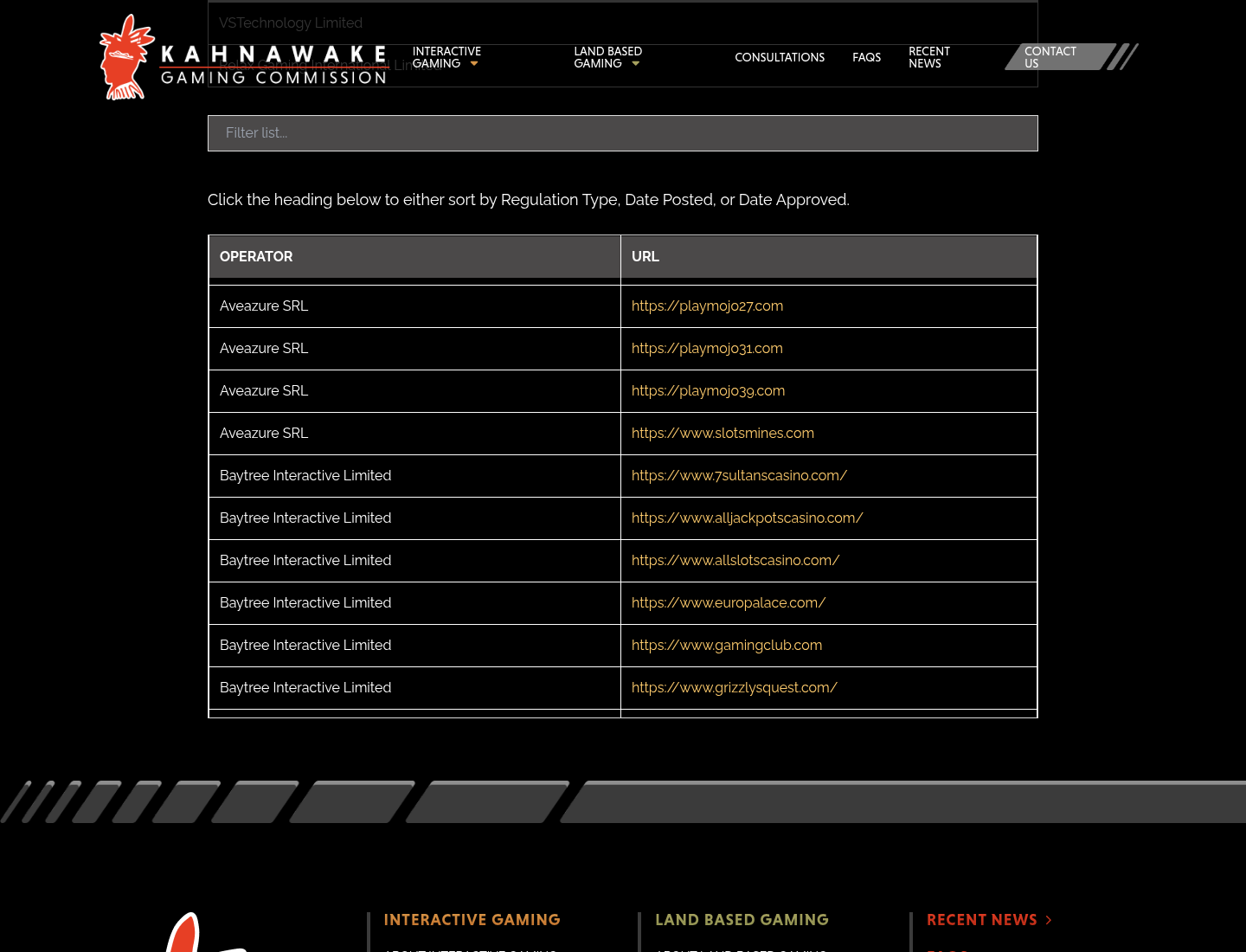
A single permit record does most of the heavy lifting in the public picture of this brand, and it was never built to answer an Indian question. The current Kahnawake Gaming Commission permit-holder listing binds Baytree Interactive Limited to allslotscasino.com, which is a clean and checkable identity link. Two independent industry publications describe the same corporate relationship in their current reviews. None of those records addresses whether the brand may lawfully accept players resident in India, and none of them was created for that purpose. That gap is the entire subject of the checks set out below. The reasonable starting position for a player in India is therefore neither trust nor alarm: the ownership question is answered, the local-status question is open, and the two must not be blended together. What follows keeps the permit record, the independent identifications, the Indian statutory source and the self-serve checks apart, so the strength of each is visible instead of being averaged into one comfortable verdict.
What the Kahnawake permit-holder record binds
The permit-holder listing published by the Kahnawake Gaming Commission is an official regulatory record, and the specific thing it establishes is narrow: Baytree Interactive Limited is bound to allslotscasino.com. That is an identity fact. It tells a reader which legal entity stands behind that domain string on the date the record was captured, 23 August 2026.
It does not extend beyond that. A permit issued in one jurisdiction speaks to the conduct that jurisdiction supervises. It carries no statement about Indian residents, Indian payment rails, Indian tax treatment or Indian advertising rules. Reading a foreign permit as a permission slip for a different country is the most common error in offshore brand assessment, and the record itself makes no such claim. Treat it as the anchor for identity verification and nothing more. Where a brand later shows a permit number or seal, the value lies in matching the entity and the domain against the regulator's own current listing rather than accepting a badge displayed by the brand.
| Record | Supports | Does not support |
|---|---|---|
| Kahnawake permit-holder listing (IN-AS-001) | Baytree Interactive Limited is bound to allslotscasino.com | Any authorisation covering India or Indian residents |
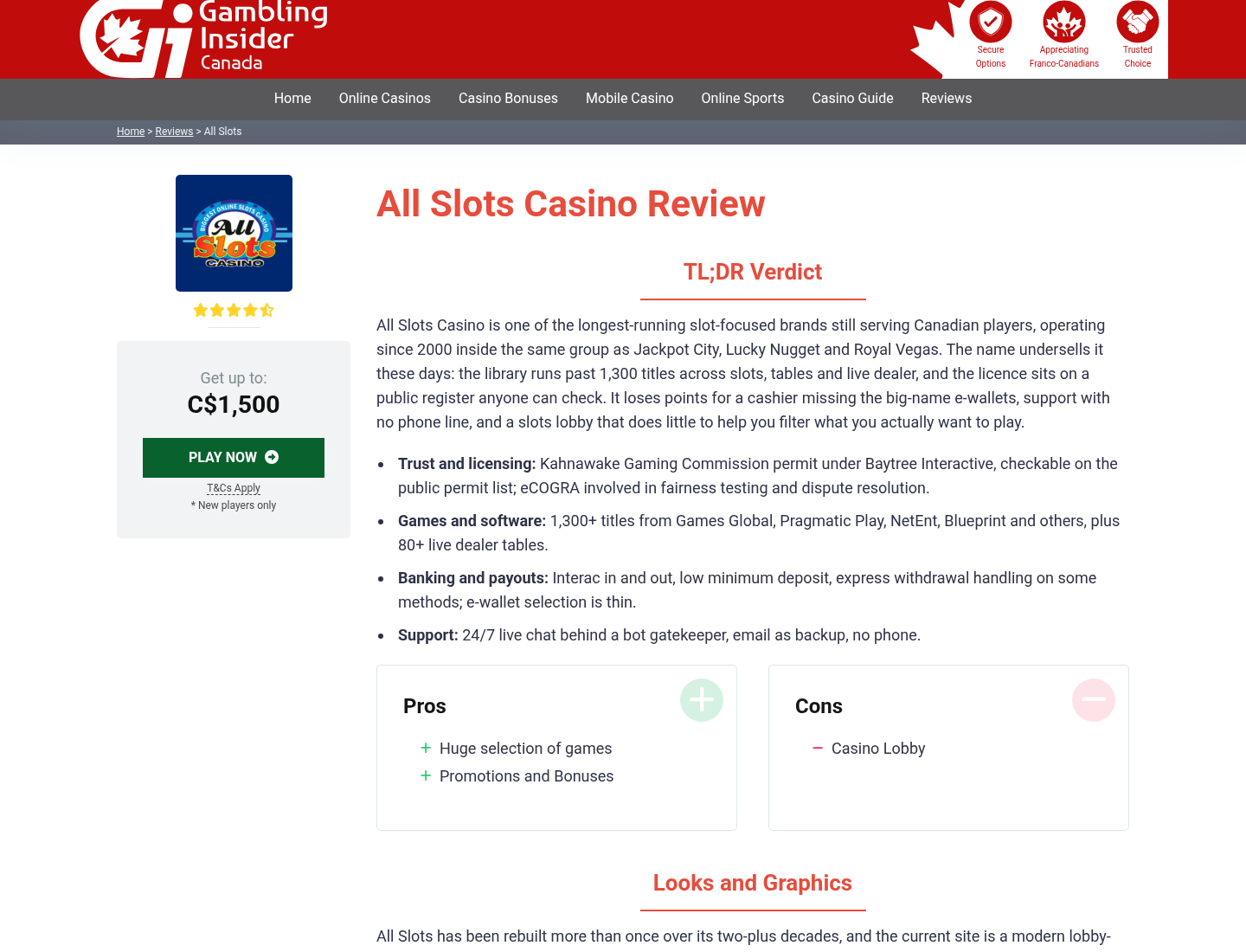
| Gambling Insider Canada review (IN-AS-002) | Independent identification of the brand and Baytree Interactive relationship | Regulatory status anywhere; it is an industry publication, not a regulator |
| Fruity Slots review (IN-AS-003) | Independent identification of the same corporate relationship | Authorisation in the target country, which it explicitly does not establish |
| MeitY Act and notification hub (IN-LAW-001) | The current Indian statutory and notification source for this scope | Any entity-specific finding about this brand or domain |
Independent identification of the same corporate link
Two sources outside the regulator describe the same relationship. Gambling Insider Canada identifies the brand and Baytree Interactive connection in its current review, and Fruity Slots identifies the same link while stopping short of establishing authorisation in the target country. Both are reliable independent publications. Neither is a licensing body, and neither should be quoted as though it were.
Their value is corroboration of identity. When three separate captures name the same company against the same brand, the risk that a reader is looking at an unrelated copycat operation drops sharply. That is useful, because brand impersonation is the failure mode that costs Indian players money fastest. What corroboration cannot do is manufacture a local permission. Independent agreement about who owns a brand tells you nothing about whether that owner may accept your deposit from Mumbai or Kochi.
India status: what the captured sources establish
The Indian statutory position for this scope sits with MeitY's current source for the Promotion and Regulation of Online Gaming Act 2025 and its notifications, preserved on 23 August 2026 as the current Act and notification hub, with legal review required. It is a hub of law and notifications, not an entity register, and it returns no brand-specific entry.
No exact current India authorization was established for this specific entity/domain combination in the captured official sources. This is an unresolved local-status finding, not proof that authorization does not exist; foreign authorization is jurisdiction-specific.
That distinction carries real weight. An absence of a captured match is a gap in the evidence, not a documented adverse finding. Anyone who converts one into the other is overstating what the records hold. A reader wanting the statutory frame in plain terms will find it in the Online Money Games Act 2026 overview, while the mechanics of testing a licence claim are set out in the India casino licence check guide.
How the amber grade is decided
Grading here follows one rule: the signal tracks the evidence, not the reputation. A green signal needs current primary evidence that fits the precise domain and entity in the market being assessed. A red signal needs an official adverse record, or corroborated documented evidence of harm. Neither condition is met.
What exists is a verified foreign identity chain, independent corroboration of that chain and an unresolved local-status question. That combination is amber on open evidence, and it should stay amber until a competent Indian source either confirms or contradicts the position. The grading rules themselves are documented in the methodology and about notes. Where a brand publicly asserts Indian approval that no record supports, the pattern is examined in the no-India-licence claim check.
Checking whether the domain in front of you is the named one
The permit record binds one domain string. Anything else — an app-store listing, a shortened link, a lookalike spelling, a mirror with an unfamiliar suffix — is outside that record until proven otherwise. Verification runs in one direction only: start from the regulator's current permit-holder listing, read the domain it names, then compare it character by character with the address in your browser.
Do not start from a link in a message, an advertisement or a search result. Do not accept a seal image as verification, because an image can be copied in seconds. If the address bar and the regulator listing disagree, treat the site as unverified regardless of how closely the design matches. Impersonation patterns and cloned installers are catalogued in the fake apps and phishing guide and the APK warning notes.
| Check | Method | What a failure means |
|---|---|---|
| Domain string match | Compare the browser address with the domain named in the regulator's current permit-holder listing | The site is outside the captured identity record; stop before depositing |
| Entity name match | Look for Baytree Interactive Limited in the site's own corporate identification | Ownership is unconfirmed against the permit record |
| Entry path | Reach the site by typing the address, never via a forwarded link or installer | A redirect chain may have delivered a lookalike host |
| Seal or badge | Verify against the regulator's listing, not the badge image | The badge proves nothing on its own |
Payment and UPI records worth capturing before anything else
Payment evidence decays. Screens refresh, app histories roll over, and a payment provider's reference becomes hard to retrieve months later. For an amber-status brand, the practical protection is not a promise from support but a complete record of every rupee that moved, captured at the time it moved.
Capture the merchant string exactly as it appears in your UPI app, because a mismatch between the displayed merchant and the brand you believe you are paying is itself a material finding. The merchant name mismatch guide explains how to document that, and the unauthorised UPI gaming payment guide covers disputed debits.
| Field | Where it appears | Why it matters |
|---|---|---|
| UTR or transaction reference | UPI app or bank statement entry | The single identifier a bank or investigator can trace |
| Merchant or payee string | Payment confirmation screen | Reveals mismatch between the displayed payee and the brand |
| Date, time and amount | App history and statement | Establishes sequence when a dispute is reconstructed |
| Account or wallet balance before and after | In-brand balance display and bank statement | Shows whether a debit reached the intended destination |
| Instruction or message received | Chat, email or in-app notice | Records what was asked of you and when |
If a withdrawal stalls: building a file that holds up
Keep allegation and record separate in your own notes too. A stalled payout is an allegation until a competent body examines it, and a file that respects that distinction is far more persuasive than one written in the language of certainty. The reference tracing steps sit in the withdrawal evidence and UTR guide, and bank-side trace routes for non-UPI transfers are covered in the IMPS and NEFT trace guide. If play has stopped feeling optional, the stop play and get help page comes before any of it.
Where a problem involving the brand can be reported in India
| Problem type | Best suited to | Where the steps are set out |
|---|---|---|
| Money lost to suspected fraud | Cyber-fraud reporting with transaction references | Financial cyber fraud reporting steps |
| Payment or bank-side grievance | Payment-system complaint escalation | Payment complaint escalation guide |
| Service or contractual dispute | Consumer route rather than criminal route | Consumer versus cybercrime comparison |
| Suspicious website or clone | Website-level reporting | Suspect gaming website check |
General escalation help is collected on the report and complain page.
Dated source ledger
Every finding above traces to one of four captures, all checked on 23 August 2026. Two are primary in role: the Kahnawake permit-holder listing as the official regulatory record, and the MeitY Act and notification hub as the current Indian statutory source, with legal review required. Two are reliable independent publications rather than regulators: the Gambling Insider Canada review and the Fruity Slots review. No operator page, support channel, forum thread or social post was used, and none should be substituted for these records. Related offshore-licence context sits in the offshore casino licence evidence guide.
Evidence-preservation checklist
- Screenshot the full browser address bar together with the page content, so the host is visible in the same frame as the claim.
- Save the regulator's current permit-holder listing as a dated capture before comparing it with any badge shown by a brand.
- Export UPI and bank statements covering every deposit and withdrawal attempt, and keep the UTR references in text form as well as images.
- Record the merchant string exactly as displayed, including spacing and abbreviations.
- Keep every KYC request and response with its timestamp, and note which document was uploaded when.
- Store the file outside the device used for play, and avoid editing images after capture.
- Write your own notes in allegation language until a competent body records a finding.
A claim you are unsure about can be run through the claim checking steps.
What would move the finding off amber
Two things would change the grade. A current, entity-specific Indian record naming the same legal entity and the same domain would support a green signal, because the identity chain is already verified and only the local link is missing. An official adverse record, or corroborated documented evidence of harm, would support red. Until one of those appears in a dated capture, the honest position is the open one.
For readers tracking what is queued for re-examination, the operator research backlog lists pending work, and broader state-level context sits in the state law context notes. Support for a family member affected by gambling is collected on the family gambling support page.
FAQ
Is All Slots Casino legal in India?
No exact current India authorization was established for this specific entity/domain combination in the captured official sources. This is an unresolved local-status finding, not proof that authorization does not exist; foreign authorization is jurisdiction-specific. The Kahnawake permit record confirms who owns the domain, not whether Indian residents may be served, and the Indian statutory position requires legal review.
Which All Slots Casino domain is genuine?
The Kahnawake Gaming Commission's current permit-holder listing binds Baytree Interactive Limited to allslotscasino.com. Verify by reading the domain from that regulator listing first, then comparing it character by character with your browser address bar. Any other spelling, suffix or installer link falls outside that record until a fresh capture proves otherwise.
How do I preserve UPI evidence for All Slots Casino?
Capture the UTR reference, the merchant or payee string exactly as displayed, the amount, the timestamp and your balance before and after each transaction. Export the matching bank or UPI statement rather than relying on app history alone, and store the file on a device separate from the one used for play.
Where can I report a problem involving All Slots Casino?
Route by problem type: financial cyber-fraud through cyber-fraud reporting with transaction references, payment-system grievances through payment complaint escalation, and service disputes through the consumer route. Suspicious clone sites go through website-level reporting. Carry your dated transaction file into whichever channel you choose.
Does the Kahnawake permit cover Indian players?
No. A permit issued in one jurisdiction supervises conduct in that jurisdiction. It establishes that Baytree Interactive Limited is bound to the named domain, which is an identity fact, and it makes no statement about Indian residents, Indian payment rails or Indian advertising rules.
Is a delayed withdrawal proof of wrongdoing?
No. A stalled payout is an allegation until a competent body examines it and records a finding. Document it precisely, keep the language of your own notes factual, and preserve the request timestamp, the amount, the method and every response received, so any later review starts from records rather than recollection.
Dated source captures